People and Economic Development
Spanish Lake faces challenges such as population loss, older homes, and limited commercial areas and jobs, but it also has unique strengths. By building on its natural areas, parks, redevelopment sites, and strengthening community partnerships, Spanish Lake can create a resilient community for the future.

Key Takeaways
Population loss, aging housing, and limited retail/jobs are straining Spanish Lake's economy and community life.
Natural assets, floodplains, and disconnected neighborhoods shape both the challenges and opportunities for growth.
WildCare Park, Jamestown Mall, and vacant land offer major redevelopment and eco-tourism potential.
A town center, better transit, and public-private partnerships can anchor a more connected, resilient future.
Issues
Regional Employment Trends
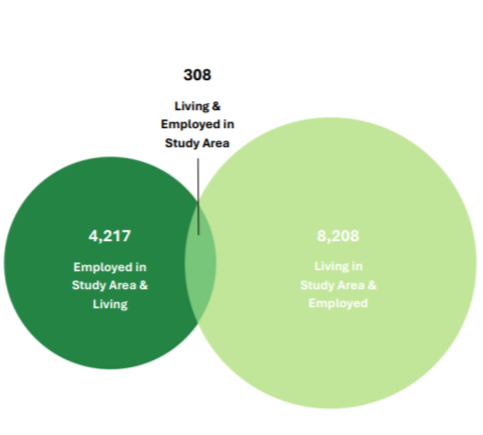
Based on Census Bureau's data, there is a very small overlap between those living in Spanish Lake Study area and those working in the Study Area. The majority of Spanish Lake's employed residents (8,208 or 96.4%) leave the neighborhood for work.
The area imports a smaller number of workers from outside (4,217) while only 308 individuals both live and work in the area. This indicates a lack of employment opportunities in Spanish Lake, as the area is largely residential and agricultural.
Workforce Characteristics
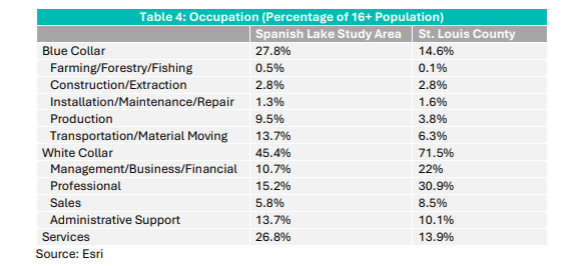
Top industries for the area are services (54.4%), retail (13.3%), manufacturing (9.5%) and transportation/utilities (7.2%). This industry mix generally tracks St. Louis County patterns though the County has a notably larger share of finance/insurance/real estate workers.
Employment Concentration
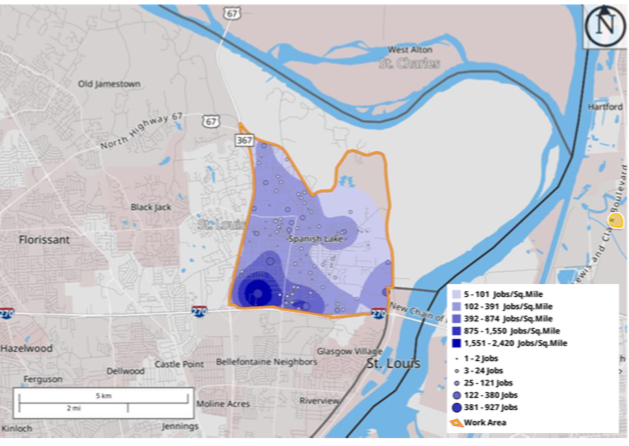
Employment distribution within Spanish Lake is most heavily concentrated in a localized node along I-270 in the Southwestern portion of the study area. Moving east along I-270 and north along the Bellefontaine corridor, the count and density of employment declines. The northeastern portion of Spanish Lake exhibits low employment activity due to existing land use patterns which limit opportunities for job creation.
Retail Leakages
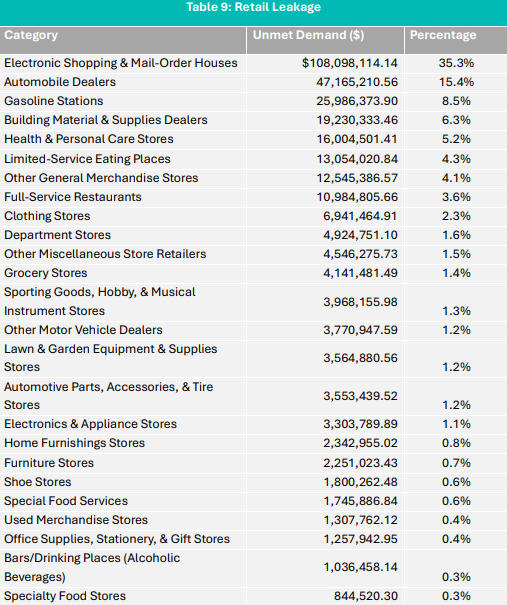
Currently, the total estimated demand for retail spending across all categories exceeds supply in Spanish Lake at $432 millions versus $ 126 million, with an unmet demand (retail gap) of $306 million.
Retail Development Patterns
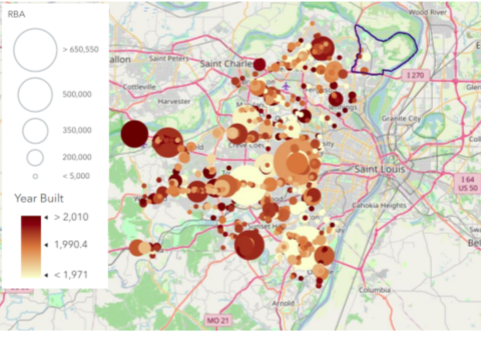
Near-term development trends for the region are forecasted to continue, though completion of a large-scale entertainment anchor, such as the Wildcare Park, can catalyze future development across a mix of uses. Aside from the park, there are a couple of smaller-scale projects currently planned within the community or directly proximate: including a proposed APA adoption center off Benham Road, and accounting for a small retail component at the Wildcare Park. Other than these proposed projects, the proposed redevelopment of Jamestown Mall is the only potential larger scale project in the northernmost area of the County.
Housing Needs
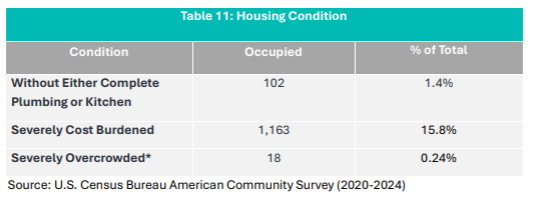
The existing housing conditions within Spanish Lake indicate a need amongst existing residents to allow for aging-in-place, and neighborhood stabilization. Across the area, 39.4% of households were experiencing one or more housing conditions, with a high percentage of households experiencing severe cost burden, and an additional need to replace substandard housing (1.4% of occupied units had either no complete plumbing or no complete kitchen facilities) or at risk for obsolescence (481 units or 6.6% of occupied housing units as of most recent U.S. census estimates were built before 1940)
Housing Income
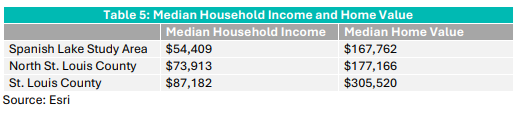
Median household income in 2025 was $54,409 and median home value in 2025 was $167,762. These figures are far lower than the County overall, which has a median household income of $87,182 and median home value of $305,520. The study area also has lower median household income and median home value compared to only the North County area ($73,913 and $177,166, respectively) The Housing Affordability Index (HAI) for the Spanish Lake area is 106, indicating that housing in the area is generally affordable to the median household, and slightly more affordable than the County overall at 99
Rental Make-up of the Area
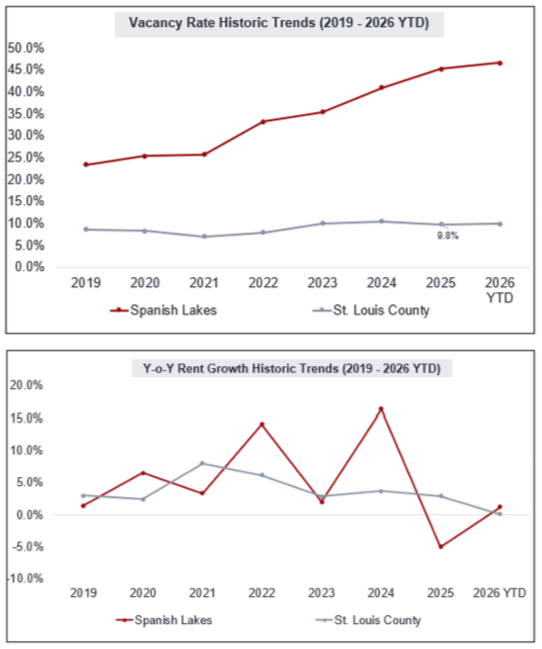
As of the first quarter of 2026, the Spanish Lake Study Area had 3,667 rental units across 11 projects classified as market-rate or mixed-income, offering both income-restricted and non-income restricted units. This represented 5% of the County inventory (over 74,000 units). The average vintage of Spanish Lake rental projects was 1970, with no new projects delivered in the market for the last several years, though a few projects have since been renovated. Average project size was 333 units, with two projects containing over 700 units each, respectively, The Residences at Bella Vista (756 units) and Spanish Cove Townhomes (787 units). Current estimated market mix was 40% 1-bedroom, 48% 2-bedroom, and 12% 3-bedroom units with an overall average unit size of 861 SF.